The Executive Presence Blueprint: An Actionable Framework from the SISO CEO Summit 2026

The New Imperative in Leadership
The event industry thrives on connection, execution, and vision. Yet, as leaders ascend the corporate ladder, a critical question emerges: what separates operational excellence from executive influence? Day 1 of the SISO CEO Summit 2026 provided a definitive answer, shifting the conversation from what leaders do to how they are perceived. The day’s sessions underscored that the next frontier in leadership development is not just about accumulating skills, but about mastering the art of executive presence. This is not an abstract concept; it is a tangible, learnable discipline that, according to insights shared during the summit, can account for a remarkable 26% of what it takes to secure a promotion to a higher leadership position.
Event Context: Setting the Stage for Strategic Dialogue
The tone for this deep dive was set early at the SISO Executive Women’s Forum. Opening remarks from Paul Miller, CEO of Questex, and Rachel Wimberly, Head of Business Development for the USA at Easyfairs, highlighted the forum’s record-breaking attendance of 125 participants. This impressive growth signals a clear industry demand for dedicated platforms that foster leadership and networking opportunities for women executives. The well-curated agenda and collaborative programming created an environment ripe for substantive discussion. Miller and Wimberly emphasized the importance of focused engagement, a theme that would resonate throughout the day, underscoring that structured interaction is key to driving organizational progress and ensuring effective knowledge transfer.
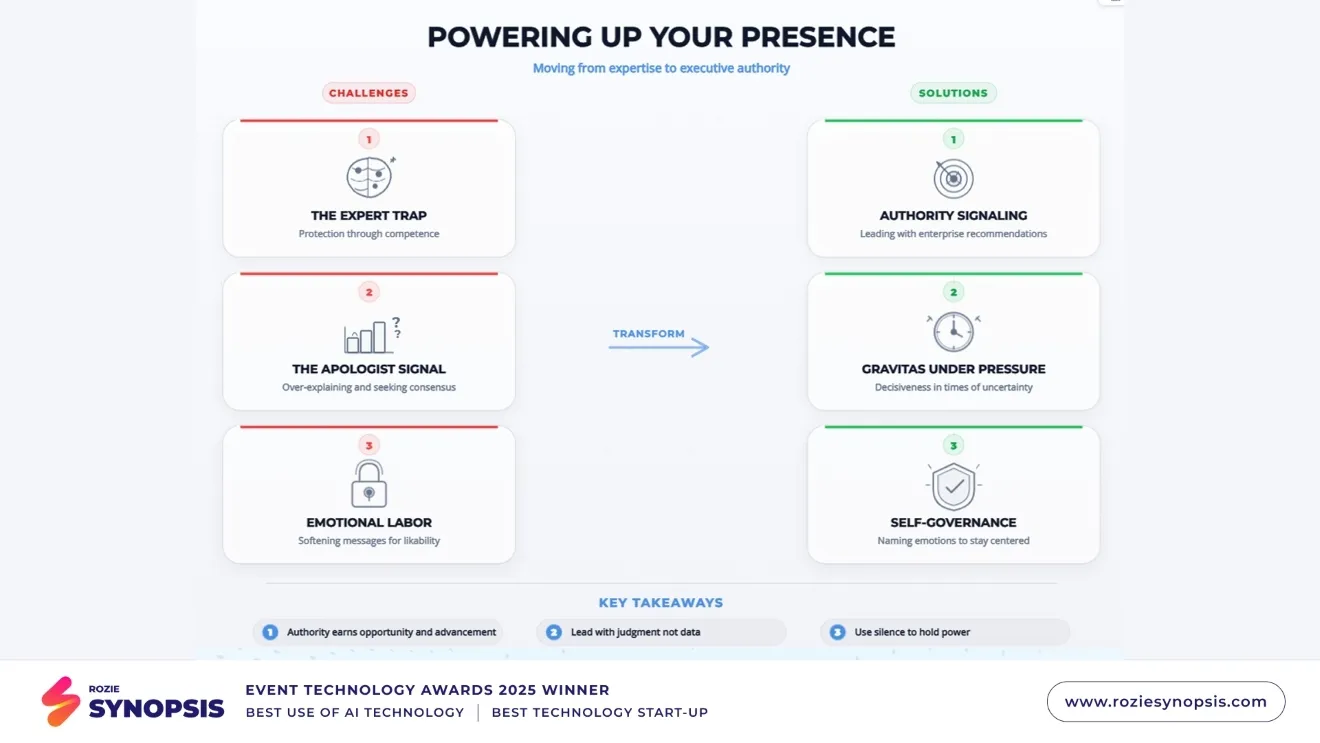
This commitment to leadership development was powerfully embodied in the day’s masterclass, “Power up your Presence,” led by Angela Scalpello, Owner and Principal of The Scalpello Group, LLC. The session moved beyond theory, providing attendees with a strategic framework for identifying, cultivating, and deploying the key attributes of executive presence. It became clear that advancing in one’s career requires a conscious shift from relying solely on competence to demonstrating authority through behavior, speech, and overall presence.
A Strategic Framework for Cultivating Executive Presence
Based on the immersive masterclass, we can distill the core components of executive presence into an actionable blueprint. This framework is designed to help leaders intentionally strengthen their influence and navigate the pressures of senior roles with greater impact. It is built on four distinct but interconnected pillars: Gravitas, Strategic Communication, Self-Governance, and Authority Signaling.
Pillar 1: Developing Gravitas Under Pressure
Gravitas is the cornerstone of executive presence. It is the palpable sense of confidence, composure, and decisiveness that inspires trust from teams, boards, and investors. Scalpello’s session revealed that gravitas is not about bravado; it is about demonstrating steady composure in high-pressure situations. Leaders who possess gravitas can remain centered and self-governed, even under intense scrutiny. Demonstrating resilience through personal stories or overcoming significant challenges with grace enhances this quality, creating a powerful connection with stakeholders.
Actionable Steps:
- Audit Your Default Behaviors: Deepening executive gravitas requires a deliberate audit of your default behaviors under stress. Do you become defensive, overexplain, or shrink from conflict? Recognizing these patterns is the first step toward managing them. Implementing practices that help you identify and articulate your emotions can improve resilience and decision-making under pressure.
- Practice Real-Time Authority Shifts: Managing career progression requires deliberate intention. In meetings or high-stakes conversations, consciously practice shifting into a more authoritative posture. This could involve speaking with more clarity and conciseness, demonstrating authoritative judgment, and avoiding the trap of seeking consensus over providing clear direction.
- Embrace Decisiveness in Crisis: The ability to lead effectively through a crisis is a critical leadership quality. Decision-making in high-stakes event scenarios often requires action without complete data. Demonstrating decisive leadership, especially amid uncertainty, significantly enhances perceptions of executive presence and leadership potential.
Pillar 2: Mastering Strategic Communication
How a leader communicates is as important as what they communicate. Strategic communication is about more than just clarity; it involves influence, messaging, and the intentional use of language and silence. The masterclass emphasized that senior leaders must move from explaining to advising, distilling complexity into a clear, enterprise-focused direction.
Actionable Steps:
- Eliminate Minimizing Language: To enhance perceived authority, leaders must eliminate apologetic and minimizing language. Words like “just” or “should” and phrases that soften a message can undermine confidence. Instead, lead with data and confident recommendations.
- Harness the Power of Silence: Effective communication involves embracing silence to enhance message clarity and foster better listening. Incorporating deliberate pauses in presentations can improve audience engagement and reinforce a speaker’s authority. Mastering the strategic use of silence demonstrates control and confidence, especially when managing disagreements.
- Foster Two-Way Influence: While strong messaging and storytelling are crucial, effective leadership communication is not a monologue. It involves fostering mutual learning and open dialogue. Cultivating executive presence requires embracing diverse perspectives without defensiveness, which enhances collaborative decision-making and strategic alignment.
Pillar 3: Honing Self-Governance and Emotional Intelligence
Self-governance is the engine of executive presence. It is the ability to manage one’s emotions, impulses, and behaviors to create a positive and intentional impact. Developing self-governance and emotional intelligence, particularly self-awareness, is essential for enhancing leadership presence and driving career advancement.
Actionable Steps:
- Practice Emotional Self-Awareness: Recognizing and naming emotions enhances emotional intelligence. This enables leaders to better manage stress and make thoughtful decisions. Encouraging emotional awareness during high-stress situations can significantly reduce physiological stress responses, enhancing effectiveness in crisis management.
- Choose Your Responses Intentionally: Leaders must consciously choose which feedback to amplify and which to absorb. This empowers them to focus on strategic priorities. Maintaining composure and asking thoughtful questions during challenges, rather than reacting defensively, enhances credibility and decision-making effectiveness.
- Curate Your Environment: Deliberately curating a positive environment enhances leadership effectiveness. This involves recognizing and managing emotional labor to foster authentic relationships without signaling deference. Intentional discipline and self-awareness are crucial for leaders to effectively embody executive presence and inspire organizational standards.
Pillar 4: Strengthening Authority Signaling
Authority signaling is the culmination of the other pillars. It is the active demonstration of your readiness for greater responsibility. Executive presence significantly influences leadership advancement by signaling the ability to carry organizational weight beyond functional expertise. It addresses a signal gap, not a capability gap.
Actionable Steps:
- Adopt an Enterprise-Wide Perspective: Frame decisions and recommendations through an organizational lens, articulating trade-offs clearly. This demonstrates strategic thinking beyond functional details and signals readiness for enterprise-level leadership. Leading with judgment over data enables strategic communication that fosters alignment across departments.
- Own Your Accomplishments: Women, in particular, can undervalue their abilities in self-assessments despite high competence. Owning accomplishments confidently, rather than downplaying them, is key to developing a compelling leadership presence. Leveraging third-party endorsements can also enhance credibility by showcasing achievements through trusted voices.
- Manage Power Asymmetries: In meetings with senior executives, effectively managing power asymmetry enhances perceived readiness for higher leadership positions. This involves balancing assertiveness with likability, confidently managing disagreements, and presenting recommendations without overexplaining or softening the message.
Relevance to the Broader Market
The insights from the SISO CEO Summit are not confined to the events industry. In any sector defined by disruption and complexity, the ability to lead with presence and influence is paramount. As organizations flatten and decision-making accelerates, the need for leaders who can inspire confidence, communicate a clear vision, and remain composed under fire has never been greater. This framework provides a universal roadmap for any professional aiming to elevate their role and influence. It recognizes that technical skills alone are insufficient for promotion; strategic relationship management, customer focus, and the ability to represent the organization to key stakeholders like investors and regulators are what truly define executive-level leadership.
A Closing Perspective
Day 1 of the SISO CEO Summit 2026 delivered more than just insights; it provided a clear, actionable blueprint for leadership advancement. The message was unequivocal: cultivating executive presence is no longer a soft skill but a strategic necessity. By focusing on the four pillars of Gravitas, Strategic Communication, Self-Governance, and Authority Signaling, leaders can intentionally close the gap between their capabilities and their perceived influence. As the summit continues, this foundation provides a powerful lens through which to view all subsequent discussions on strategy, innovation, and the future of the industry.
—-----------------
This article was created using Rozie Synopsis - An award-winning AI-native event experience platform that helps organizers turn event knowledge and booth conversations into reusable knowledge and measurable ROI through persona-optimized experiences.
Follow us for more content around the future of events.